
Talking funny
doing it anyway. Vom Mutterland 003

We were in a loud bar and I was speaking to a loud German man. He’d been found by Ewan and Alfie a few hours earlier, almost immediately after they’d left their shoddy hostel, temporarily released from my supervision while I rushed home to put on makeup and change into a shorter skirt. The sky was draped in that artificial, fuzzy early-evening darkness of December, one which so suits Berlin (of course the nights should be longer – we have so much to do in them), and it was with this feeling of potential that the boys had bounded onto the street. Only natural, then, for the city to respond to their dare.
As soon as he’d seen them, he’d ‘caught their vibe’, the loud German man was telling me now. They had compelled him. I smiled under dim yellow lights as he explained to me the magic which I know so well, having been caught in it myself and witnessing it on others many times over. Hearing a stranger assess people I love so dearly gave me a proud, amused buzz. He’d sensed that thrilling thing which so many people sense on Ewan and Alfie: that interesting and chaotic things live here, that this pair would nurture, encourage, and then reward boldness, that there was something very alive and spontaneous to be gained if one could only manage to stay in proximity to these two young, beautiful boys.
But now, the loud German man was focused on me – I’m sure in no part influenced by the aforementioned short skirt – and getting very excited about my accent. The boys hadn’t told him I could speak German, or they had, but he’d forgotten, and so the first time I turned to him and replied in his own language, he made a whole performance of shock and awe. It continued whenever I switched languages, him making a loud German noise, like booooaaaaar or saying things like alter, das ist so koooomischhhhh or alter, das ist zuuu viiiieeeeel.1 He was very obnoxious (and would later become even more so, shrieking in the back of our Uber as the rest of us shot each other pointed looks, sealing a silent agreement that, once at Renate, we would see what could be done about perhaps handing him back into the night as seamlessly as he had emerged out of it), but, for that moment, I was flattered by the attention. Slightly high on the rush of smoking indoors, enjoying someone from the country I’ve idolised so profoundly in the last few years being so interested in my voice.
Normally, I get self-conscious when speaking to other Germans. My English accent is painfully middle-of-the-road, exactly what oversimplifying foreigners mean when they designate ‘an English accent’, but in German, my tongue is vulnerable to a whole mix of twangs and influences.
It’s part of why I still sometimes just default to my English even when we could both be speaking German. I’m infinitely more forgiving of other people’s oddnesses and mispronunciations than my own. In fact, forgiving is too neutral, I actually find it acutely delightful. There is no better inspiration for a poet than watching someone linguistically dance around well-worn phrases, coming up with new ways to express themselves for the lack of any other option, whatever they’re trying to say deemed important enough to put the work in, to craft understanding.
There is also, obviously, The Disease to contend with (no mistakes for Maja! I must be perfect lest I die!) and I’ve caught enough odd looks in the midst of conversations to know I only get away with sounding like a native for a few minutes. At some point, inevitably, I will be betrayed by an unfamiliar word or a skewed vowel, my English accent scraping in, me cringing lightly as the words come out in a way I know is wrong but don’t understand exactly why. My cover is always blown, eventually.
One tactic I’ve learned is to just drop English words into sentences while giving them a slight German accent. No one bats an eye, even when they don’t (yet) suspect I’m bilingual, because human communication is astoundingly non-verbal. I can leave whole words out of a _______, and you’ll still _________ what it is that I’m trying to ___. We hear things in our native languages which we don’t understand all the time. We just don’t realise we’re filling in the gaps.
This trick is even better on younger Germans, who do the same thing because it’s cool and young and European, and so will assume you are also cool and young and European and – crucially – not that you’re barrelling into the starts of sentences with pure blind hope you’ll make it to the end in one piece.
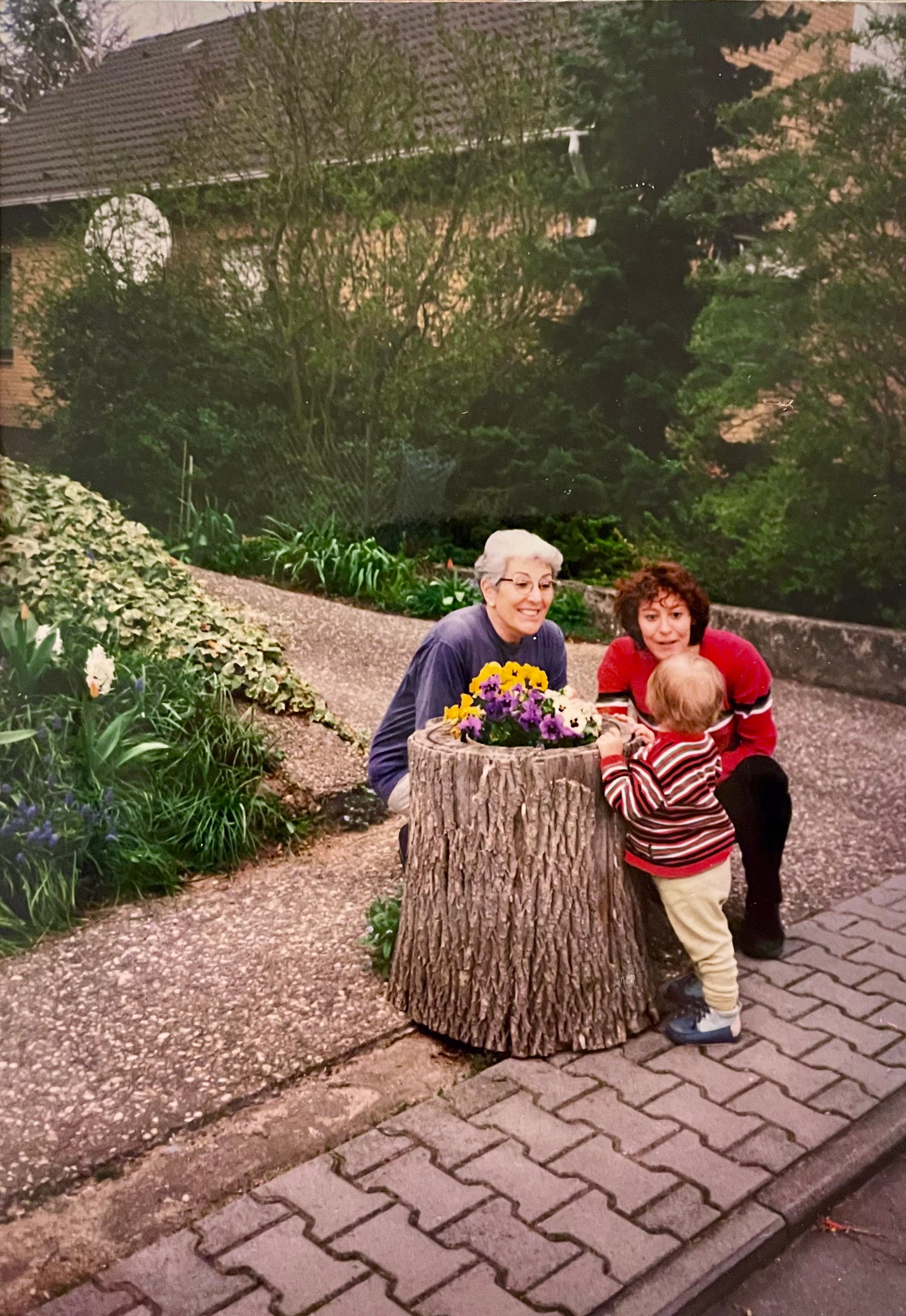
The native German accent I do have, for as long as it sticks around, is extra confusing because it echoes the thick Hessian accent2 of Mum’s childhood: a round, undulating, soft inflexion. The starts and ends of words often smear in towards the middle. Hessians drop their ns, a bit like a Brit dropping their ts. The sch noise gets smudged over basically every other letter, the sound held low in the mouth, closer to a djh noise than an shh. Voices rise and fall through sentences in a way which reminds me of the Norfolk accent: another warm, rural tone which unlocks a specific compartment in my heart, comforts and delights and overwhelms all at once.
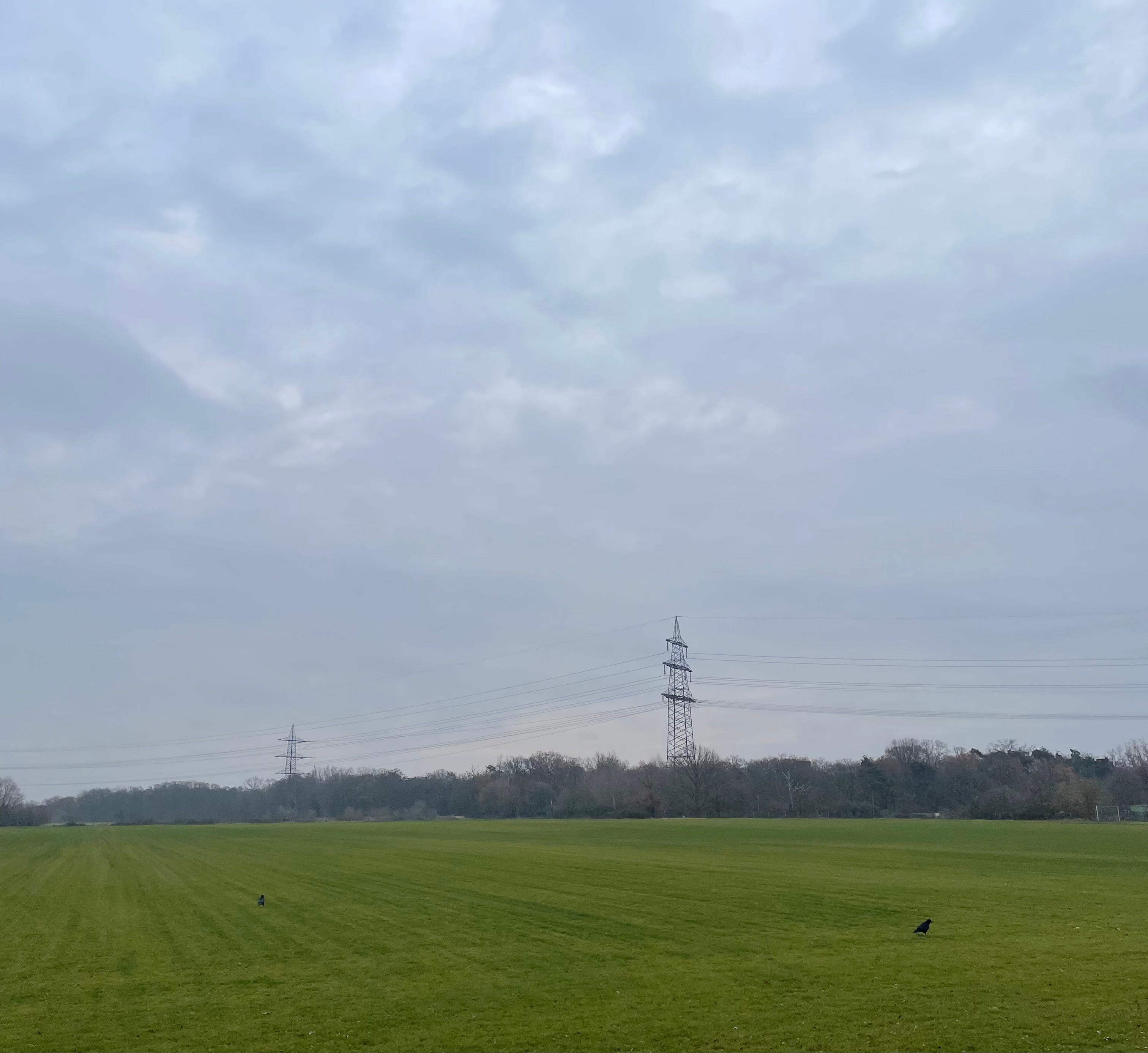
The week before Ewan and Alfie came to Berlin, I went back to Bauschheim, primarily to visit my auntie Ute. But also just to see it for myself again, to tick off a packed itinerary of walking around and acting weird. The house looks very different now. Walls have moved. The kitchen is the bathroom, the bathroom is a storage cupboard. It makes me feel a bit like a confused ghost. To soothe myself, I go through the rooms and point at places and state the past. That’s where the grandfather clock was. This is where she slept. We used to put the tree right there.
There’s a desperate, almost frantic missing for the old house when I do this, the panic of realising you didn’t realise the last time you’d do something, and that the object of your yearning is now distantly out of reach. But it’s good, really, for the place to have been changed. If it were all the same I doubt I’d be able to even cross the threshold, doomed instead to loom like a vampire in the doorway, seeking permission, waiting for my Oma to come back around the corner as she’s meant to, waiting for her to bring me in, bring me home.
On my first night there, Ute showed me Beetgeflüster, a local podcast which interviews people from the village. The next day, I listened to a few episodes on a long, meandering stroll through the woods we played in as kids. I listened about the Bürgerhaus and the Kerwe while I walked the route we used to cycle to the ice cream parlour when our boredom reached unmanageable levels and needed to be tempered with Straciatella and Himbeer. I let the voices of people who have lived here a long time fill my head and let my heart break a little at every corner.

That evening, I went to have dinner with Mum’s best friend. Birgit’s been around for my whole life, but, sitting there in her kitchen, it felt distinctly like a (re?)introduction. When her husband Kai got home, he kept pulling away from our hug to get a better look at me, to marvel at what time had done to the little wild thing.
I told them about Berlin, my mini-estrangement from my own life, my failed relationships, the growing anxiety of approaching the age my parents were when they got married and had me. Birgit told me about first befriending Mum over 30 years ago, how enchanted she was by her, how devastating it was when she moved to the UK. Stories of faith, belief, worry, joy, and we did it all in German.
The next night, Ute and I talked for three hours over a bottle of wine, feet tucked under us on the sofa, soft blankets strewn half across our legs, sounding more like old friends than niece and aunt. At one point, the strange familiarity got to us and as she wiped tears from her eyes, Ute said, hints of that Hessian accent peeking through: “Man, guckema…! Wie wir reden!” Just look at the way we’re talking.
My Opa grew up speaking Czech and never lost his accent. My Mum’s voice confuses everyone. They always guess Polish or Italian long before German. Three generations, each of us with our own weird and interesting sound, living and moving through places we sort of belong and sort of don’t. Working to find imperfect ways to say the important things, making people laugh and not knowing why, talking with all the threads showing.
Beetgeflüster: beetroot / whisperings
Bürgerhaus: resident / house, meaning community centre or town hall
Kerwe: carnival
Guck mal: look / time (but like, time as in the amount of times you do something, eg. first time, second time), meaning take a look at that
Guckema: how you say guck mal when you’re from Bauschheim
A German noise for when you’re a bit stressed out - “mate that’s so fucking weird” - “mate this is too fucking much” - in that order
While writing this I found this website which actually hosts a bunch of soundbites of Hessian slang and they’re soooooo cute